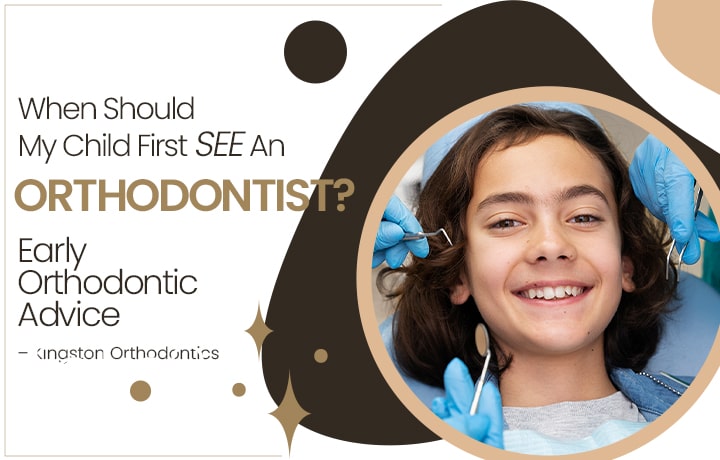
When should my child first see an orthodontist? Early Orthodontic Advice – Kingston Orthodontics
Discover the best age for your child’s first orthodontic visit. Learn when to see an orthodontist, early signs to watch for and benefits of early treatment at Kingston Orthodontics in Kingston upon Thames.
As a parent, you naturally want the best for your child — and that includes a healthy, confident smile. One of the most common questions we hear at Kingston Orthodontics is: “When should my child first see an orthodontist?”
The answer might surprise you: the ideal age for your child’s first orthodontic assessment is around 7 years old. Even if your child still has baby teeth, an early visit helps your orthodontist identify potential issues with tooth development, crowding and bite issues.
Why Age 7 Is the Magic Number
At around age seven, your child’s mouth is a mix of baby teeth and emerging adult teeth, orthodontists call this the “mixed dentition phase”.
This stage allows orthodontists to:
- Spot early growth or bite concerns like crowding, underbites, overbites or crossbites
- Guide jaw development to create enough space for new teeth
- Prevent complex treatment later in the teen years
- Discuss digit sucking habits and provide advice on techniques to stop these habits in a supportive and caring way
In most cases, no immediate treatment is needed — but early observation gives your orthodontist a clear picture of how your child’s smile is developing.
What Happens During a Child’s First Orthodontic Visit?
At Kingston Orthodontics, we make your child’s first visit very relaxed and a positive overall experience.
Here’s what to expect:
- Friendly introduction – We make sure your child feels comfortable in our Kingston practice
- Examination – The orthodontist checks your child’s teeth, bite, and jaw growth
- Digital scans or X-rays (if needed) – To evaluate tooth position and development
- Discussion – We explain whether treatment is needed now, later, or not at all
Benefits of Early Orthodontic Assessment
Early orthodontic visits can make a huge difference in your child’s oral health and confidence.
Here are the key advantages:
Benefit Why it matters
Early detection Early or late loss of baby teeth
Orthodontic assessment Identify crowding, bite issues or jaw misalignment
Guided growth Influence jaw and tooth development at the right stage of your child’s growth
Habit cessation Assist parents to find the best techniques to stop thumb sucking or digit sucking habits
Easier treatment Potentially reduce the need for dental extractions or longer treatment later
Boost confidence Reduce self-consciousness and improve self-esteem as your child’s smile develops
Which braces work for early orthodontic treatment?
- Palatal Expanders
Gentle devices that widen the upper jaw to create space for adult teeth to grow into and correct narrow upper jaws and crossbites. These expanders work best while your child’s bones are still growing. These braces can be in the form of a removable plate with an expansion screw, a fixed expander (Quadhelix or Hyrax expander) or an Invisalign® Palatal Expander (IPE)
Benefit: Creates space for teeth and reduces future crowding
- Space Maintainers
If a baby tooth is lost early, this removable appliance keeps the gap open for the adult tooth to come through properly.
Benefit: Simple, preventive, and effective
- Clear Aligners (Invisalign First®)
Designed for children between the ages of 6-10 years, Invisalign First® offers a discreet way to treat mild crowding or spacing in younger children.
Benefit: Comfortable, discreet and removable for easy cleaning
- Functional Appliances
Removable devices (such as Twin Blocks) that guide jaw growth and correct early bite issues. They can help balance facial development and prevent more complex jaw discrepancies later on.
Benefit: Effective bite correction in a growing child
- Partial Braces (Phase 1 Braces)
A small section of a fixed brace on the front teeth to correct alignment issues or spacing within a short period of time.
Benefit: Effective correction of alignment of the front teeth
What If My Child Doesn’t Need Treatment Yet?
That’s perfectly fine and in fact, it’s very common. Most children will then require dental growth and jaw growth observation. Your orthodontist will advise on how often they will need to see your child to monitor this. Usually this will be every 12 or 24 months depending on your child’s teeth and bite.
This proactive approach helps to ensure your child gets the right treatment at the right time and only if and when clinically needed.
Orthodontic Care for Pre-Teens and Teens
If your child is a tween or already in their early teens and hasn’t seen an orthodontist yet then don’t worry. Orthodontic treatment begins between the ages of 11 – 14 years for many children. At this age, most the permanent teeth will have erupted and the appropriate orthodontic treatment plan will be discussed with you and your child.
Why Parents Choose Kingston Orthodontics
A large number of our patients come to us through word of mouth which is a reflection of the trust that families and local dentists have in our specialist team at Kingston Orthodontics. We make every visit comfortable, informative, and tailored to your child’s needs, whether it’s early monitoring or full orthodontic treatment. Our patient-centred, specialist care allows are dedicated team to focus on clinical excellence and patient comfort throughout treatment.
Ready to Book Your Child’s First Orthodontic Visit?
Give your child the best start for a healthy, confident smile.
Book a consultation with Kingston Orthodontics today, our friendly team are ready to guide you through every step.
FAQ – Common Questions About Early Orthodontic Visits
- Why is age 7 the best time for an orthodontic check?
At this age your child will have both baby teeth and adult teeth. An orthodontic assessment at this age allows your orthodontist to see developing bite and jaw patterns early - Does my child need braces right away?
Not usually. Most children are simply monitored until the ideal time for treatment. - What braces would work for my child at this age?
There are a variety of braces that can be used in younger children. Some braces are designed to provide early arch expansion or arch widening whilst others focus on aligning the front teeth. Your orthodontist will advise you on the best treatment plan for your child
- Are early orthodontic visits covered by the NHS?
NHS orthodontic treatment is available for qualifying children with moderate to severe needs, but an early private assessment can still be valuable for peace of mind. - What if my child is older than 7?
It’s never too late! Many patients start orthodontic treatment during their preteen and teenage years.
Popular Posts
How long does orthodontic treatment take
Oct 09,2025
Frequently Asked Questions about Invisalign
Nov 29,2024
Commonly Asked Questions About Fixed Braces
Nov 29,2024
How Braces Perform Teeth Straightening
Sept 18,2024

Do’s and Don’ts of Wearing Invisalign Braces
Apr 18,2024
How do braces correct overbites
Oct 31,2023